
Pruning Prunus mume for Ramification
In 1964, Lynn R. Perry (aka. Lynn Perry Alstadt) published Bonsai: Trees and Shrubs: A Guide to the Methods of Kyuzo Murata. In it she revealed—for the first time in English, to my knowledge—how to prune Prunus mume (Flowering Apricot, Mei, Ume) for ramification.
There are several ways to do it, but the method Perry learned from Murata at Kyuka-en in the Omiya Bonsai Village in the early 1960s is a reliable one. Since she put it in print, we've had no excuse to pretend that Prunus mume is any harder to develop than the other species we grow as bonsai.

With their first flush of growth after flowering, Prunus mume tend to prioritize shoot extension at the tips of existing branches (this isn't true of every cultivar, but the exceptions are rare). Because of this, the uninitiated often end up with branches that get longer year after year, quickly deteriorating the bonsai's silhouette—or outgrowing the intended silhouette.
So how do we promote shoot extension closer to the trunk? The work begins almost a year in advance, sometime around May or June.
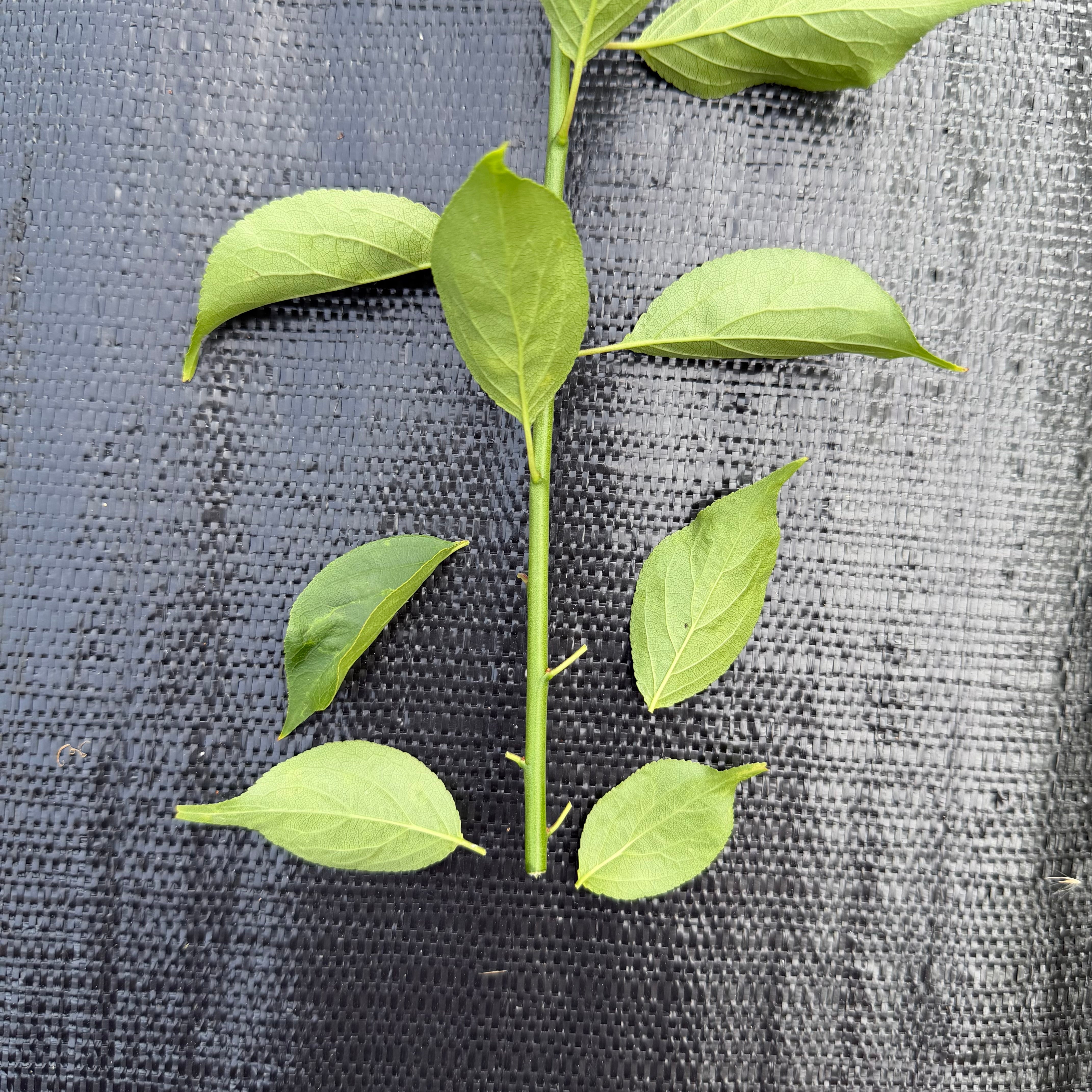
At the base of most leaves are buds.

There are two types of buds that can form: buds that will produce flowers, and buds that will produce shoots and leaves (vegetative buds). In winter, the distinction will be more obvious as in the photo above. In June, it can be more difficult to discern.
An internode can have:
- only flower buds
- only vegetative buds
- or both types of buds
If left untouched, in general a Prunus mume will prioritize the development of vegetative buds closer to the tips of its branches (the tree wants to get BIG).

Our goal is to encourage the formation of vegetative buds closer to the base of the shoot, thereby producing a potential for tighter ramification.
Step 1
Strip away the first 2-4 new leaves at the base of each shoot (image above). It is believed that the lack of a solar panel at this location will promote the occurrence of vegetative buds at the base of those petioles while discouraging the generation of flower buds at those sites.

Step 2
When deciding what to do with the rest of the branch, you have 3 options:
Option 1: Do not prune the shoot at all. In this case new growth this season is likely to occur at the tip of the branches, promoting overall branch thickening. It is unlikely that new shoots will emerge this year from the internodes where you removed the leaves, but you will have significantly increased the likelyhood of that occurring next spring. (In this scenario, the safer option is to prune your branches in fall after leaf drop. You can also prune your branches right after the flower show, but this can be compromised by late flowers or early vegetative bud movement).
Alternatively, you may want to consider the approach explained by Bjorn Bjorholm (Eisei-en Kyoto) in his video on Youtube called Defoliating Flowering Apricot Bonsai
Option 2: cut each shoot back to 5-6 new leaves. In my experience this is significant enough to provoke new shoots to emerge this season from the internodes where you removed the leaves.
Option 3: In the image above I cut back to 2 leaves, which will dramatically stunt the thickening of the branch. This is most appropriate for trees in advance stage of refinement.
Fair Warning
Option 1 will yield the greatest volume of flowers in the coming winter, but it's not great for attaining advanced-stage ramification on refined trees. it is best used to create simple bifurcations where we need them while developing branches.
Option 2 is a middle ground.
Option 3 will greatly diminish the tree's flower display in January-March, but it is an important sacrifice to make to ultimately end up with show-level ramification

Step 3
If the tree is vigorous and your timing is correct new shoots will begin elongating within 1-3 weeks.
If new shoots do not emerge, that's fine: next spring new shoots will emerge from those internodes where the leaves were removed.
In the image above, 4 shoots emerged. I could potentially prune back to the 2 most desirable shoots (consider internode length and direction). In step 1 you could have removed just 2 leaves instead of 4, in which case at this point you would have only 2 options to work with.
If this new elongation phase has a lot of vigor AND there is sufficient time before Fall, one could repeat Step 1 and Step 2 to these new shoots. This will yield even more ramification! I have done Step 1 and 2 up to 3 times in a single growing season with great results and rapid ramification development (I use a cold frame to elongate my growing season here in Montreal).
Important Considerations
When the new shoots emerge in June-July, we need to be conscious about internode length; if the new growth is weak/short, it may be desirable to have next year's shoots emerge from the tips of these new shoots. Blindly repeating Step 1 here could create ramification that is just too tight (we run into the same situation with Shishigashira and Koto Hime Japanese Maples).
We also want to think how many solar panels we're leaving on the tree, and whether they're balanced across the tree, so that our interventions today align with the kind of growth we desire next spring.
%20published%C2%A0Bonsai:%20Trees%20and%20Shrubs:%20A%20Guide%20to%20the%20Methods%20of%20Kyuzo%20Murata.%20In%20it%20she%20revealed%E2%80%94for%20the%20first%20time%20in%20English,%20to%20my%20knowledge%E2%80%94how%20to...)